The First 100 Days After an Acquisition
What a new owner does in the first three months determines whether employees and customers stay. A practical sequence for day one, the first month and the first quarter.

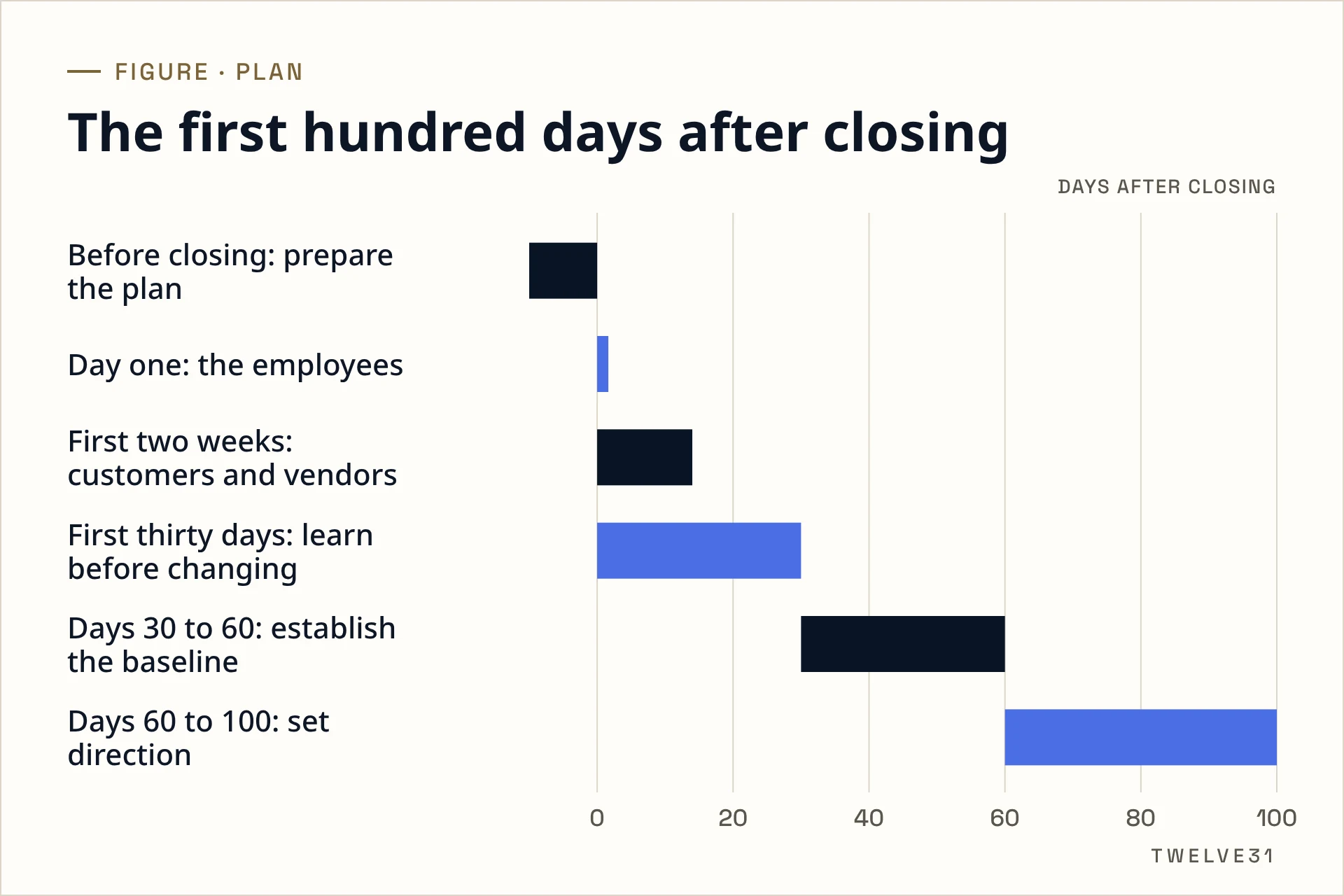
The first hundred days after closing decide whether the employees and customers a buyer paid for remain with the business. In a small company, goodwill resides in people and relationships, and both are unsettled by a change of ownership. The new owner's priorities in this period are to retain what was purchased, understand how the business actually works, and take control of cash. Significant changes can wait.
Before closing: prepare the plan
The work begins before the transaction is complete. A buyer should arrive on the first day with several things already settled.
- A communication plan for employees, customers and vendors, agreed with the seller.
- Operational readiness. Bank accounts, payroll, insurance, licenses, merchant processing and software access set up to function immediately.
- A transition schedule defining what the seller will do and for how long.
- A thirteen-week cash flow forecast, since the buyer is beginning with new debt and often limited working capital.
- Access to every system: domain registrar, website host, email, accounting software, point of sale, e-commerce store, phone system, social media accounts and alarm codes, each confirmed to transfer.
- Licenses, permits and registrations in the new entity’s name. For food businesses that includes FDA food facility registration and any state food establishment permit; in dental and healthcare, provider credentialing with insurers. These can take weeks, so start before closing where possible.
 (opens a larger view)
Day one: the employees
Employees should hear the news from the seller and the buyer together, in person, on the day of closing or the next morning. They will have three questions, whether or not they ask them. Is my job secure? Will my pay or benefits change? What will be different?
The buyer should answer directly. If no changes to staffing or compensation are planned, say so. If the buyer does not yet know something, say that as well. Promises that cannot be kept do lasting damage.
Payroll must be correct and on time in the first cycle. Nothing undermines a new owner faster than an error in the first paycheck.
After the group meeting, meet individually with each key employee. Ask what they do, what works well, what frustrates them and what they would change. Those conversations yield more reliable information than any diligence report.
The first two weeks: customers and vendors
Buy-side
Discuss an acquisition
An initial conversation is confidential and carries no obligation.
Contact the advisory teamThe seller should personally introduce the buyer to the most important customers, in person where possible and by phone otherwise. The message is continuity: the same people, the same service, and a new owner committed to the relationship.
The buyer should mostly listen in these meetings. Ask why the customer buys from the company and what could be done better. Avoid announcing changes to pricing or terms.
Vendors and other partners deserve similar attention. Suppliers need to know that invoices will be paid and may need new credit applications. The landlord, the banker, the insurance agent and any franchisor or licensing authority should hear from the new owner early.
Start with the largest customers, typically the top twenty. Thank them for their business and ask what they value. Unless the deal plan requires it and customers have been told, do not raise prices in the first month.

The first thirty days: learn before changing
Buyers arrive with ideas for improvement, and many of the ideas are sound. The discipline is to delay acting on them. A new owner does not yet know why things are done as they are. Practices that appear inefficient sometimes exist for reasons that become clear only with time.
There are exceptions. Matters involving safety, legal compliance, cash controls or dishonesty should be addressed immediately.
Use the first month to observe. Spend time in each part of the operation. Learn the systems. Use the seller, who is available for a limited period, to explain the history behind customer arrangements, pricing and personnel.
Take control of cash
A newly acquired business has less margin for error than it had under its former owner, because it now carries acquisition debt.
- Review cash weekly against the thirteen-week forecast.
- Understand the collection cycle and follow up on overdue receivables.
- Approve all disbursements personally for the first several months.
- Confirm the working capital delivered at closing and prepare for the post-closing adjustment, if the agreement provides for one.
- Calendar loan payments, covenant tests and reporting deadlines to the lender and, where applicable, the seller.

Days thirty to sixty: establish the baseline
By the second month the owner should be producing timely monthly financial statements and tracking a small set of operating measures. The specific measures depend on the business, but most owners need to see revenue, gross margin, labor cost, cash, receivables and a measure of the sales pipeline or backlog.
Compare what you are seeing with what diligence led you to expect. Differences should be investigated. If something material was misrepresented, the purchase agreement sets deadlines for making a claim, and those should be reviewed with counsel.
This is also the time to identify a few improvements that are visible, inexpensive and welcome. Repairing equipment that has frustrated employees for years, or resolving a long-standing customer complaint, demonstrates that the new owner listens and acts.
Several changes usually pay off in this period:
- Fix the monthly close. Books closed by the 10th of the following month, reconciled to the bank, with a one-page summary of revenue, gross margin, payroll and cash. If the business was on a once-a-year accountant cycle, this is often the most valuable single change.
- Map the top five processes (quoting, ordering, scheduling, fulfillment, billing) as they actually happen today. The rework becomes visible.
- Review pricing against the cost to deliver. In many owner-run businesses prices have not moved in years. Plan a measured increase with notice rather than a shock.
- Inventory the systems. List the tools in use, what each costs and where staff re-type data. Remove nothing yet; the list becomes the systems plan.

Days sixty to one hundred: set direction
With two months of observation, the owner is in a position to decide on priorities. Choose a limited number, perhaps three to five, for the first year. Share them with the team and explain the reasoning.
Address personnel questions deliberately. If a key employee is essential, consider a retention arrangement. If someone is clearly wrong for the role, act once the facts are established. Prolonged uncertainty harms the rest of the staff.
Begin transferring the seller's remaining responsibilities so that the business is fully independent by the end of the transition period.
Put the priorities on one page for the rest of the first year, each with an owner, a deadline and a measure. Decide who takes over whatever the seller has been doing, such as sales, estimating or the books, when the consulting period ends. Send the lender and investors a clean first report: monthly financials, covenant calculations and a short narrative on what is going well and what is not. Lenders forgive bad news far more readily than surprises. Then hold a team meeting on the plan: what was heard in the first month, what stays and what will change.
Working with the seller
The seller is a valuable resource for a short time. Use that time for what only the seller can provide: introductions, history and context. Agree on a schedule and on who decides what.
Boundaries matter. Employees may continue to go to the former owner, and the former owner may find it difficult to watch changes being made. A clear understanding from the outset, and a defined end date, serve both parties. Where the seller holds a note, a good working relationship also protects the seller's interest in being repaid.

Common mistakes
- Changing too much too quickly
- Reducing pay, benefits or staff in the first weeks without a compelling reason
- Raising prices before understanding customer relationships
- Neglecting the largest customers
- Underestimating working capital needs
- Keeping employees uninformed
- Ending the seller's involvement too early, or allowing it to continue too long
- Once disbursements are delegated, require two-person approval on payments above a set amount.
- Watch collections closely. They often slip during a transition, because the person who used to call slow payers was the former owner.
- Rebranding in the first hundred days; a name customers have known for decades is an asset
- Letting go of the employee who knows where everything is
- Starting a major software migration in the first month

A 100-day scorecard
At day 100, the owner should be able to answer yes to most of these:
- Cash. The 13-week forecast is updated weekly, with no surprises.
- Books. The monthly close is done by the 10th and tied to the bank.
- People. No unplanned departures of key staff.
- Customers. The top twenty have been contacted, with no unplanned losses.
- Compliance. All licenses and registrations are in the new entity’s name.
- Systems. The tools are inventoried and the top three fixes chosen.
- Plan. A one-page first-year plan has been shared with the team.
- Lender. The first report was delivered on time.
What success looks like
At the end of a hundred days, a well-managed transition shows certain results. The key employees are still in place. The principal customers have met the owner and continue to buy. Financial statements are current and cash is forecast. The owner understands how the business operates and has a short list of priorities the team supports. From that position, the improvements the buyer had in mind at the outset can be pursued with far better prospects of success.
Twelve31 Advisors remains engaged with acquirers after closing, including transition planning and ongoing board-level support.