SBA 7(a) Acquisition Financing: How It Works After October 2026
The SBA 7(a) loan remains the primary way to finance the acquisition of an established, privately held company. What the October 2026 rules require for equity, cash flow, valuation and seller notes.

The SBA 7(a) loan is still the primary source of financing for acquisitions of established, privately held companies, and it became harder to qualify for on October 1, 2026. Loans numbered on or after that date fall under a revised rulebook that tests cash flow on historical results only, raises the required coverage ratio, and caps total debt at the appraised value of the business. Buyers who structure offers on the earlier rules will find them declined.
In brief
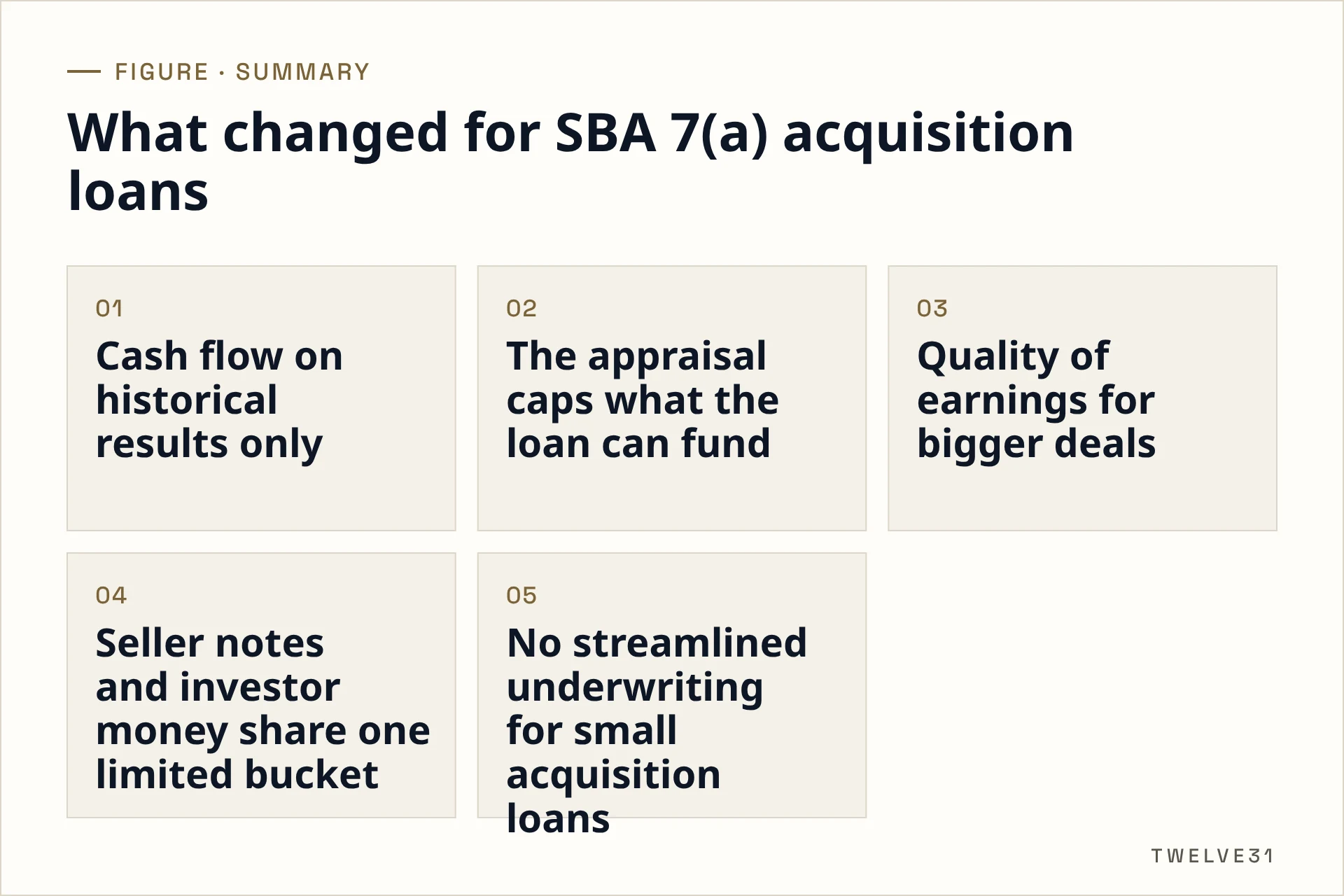
The rules apply to any loan that receives an SBA loan number on or after October 1, 2026, regardless of when the buyer first spoke with the lender. Five changes matter most:
- Coverage on history. An initial acquisition needs debt service coverage of at least 1.25x on historical earnings. Projections do not count toward the minimum.
- The valuation sets the ceiling. If the price is above the independent valuation, the difference comes from buyer cash or full-standby sources, not loan proceeds.
- Quality of earnings on larger transactions. A purchase price of $3 million or more requires an independent quality of earnings report.
- A firm equity floor. The 10 percent injection for an initial acquisition cannot be waived, and seller notes and small minority investors together may supply no more than half of it.
- No streamlined underwriting. Every change of ownership goes through full underwriting, regardless of loan size.
Each of these changes a conversation that happens before the letter of intent is signed.
 (opens a larger view)
How the program works
The SBA does not lend directly. A bank makes the loan, and the SBA guarantees a portion of it, generally 75 percent on loans above $150,000. The guarantee allows banks to finance acquisitions that have little hard collateral, since most of the purchase price in a small business is goodwill.
The basic terms are favorable compared with conventional lending.
- Loan size. Up to $5 million.
- Term. Ten years for a business acquisition, fully amortizing with no balloon. Where owner-occupied real estate is included, that portion may run up to twenty-five years, and the maturities are blended.
- Rate. Usually variable, tied to the prime rate, subject to SBA maximums.
- Fees. An upfront guaranty fee that scales with loan size and is set each fiscal year, typically financed into the loan.
- Guarantee. A personal guarantee from every owner of 20 percent or more.
Four categories of transaction
The revised rules sort every change of ownership into one of four types: an initial acquisition, a business expansion, an owner buyout, or a purchase by an ESOP or cooperative. Requirements differ among them. A first-time buyer acquiring a company falls in the initial acquisition category, which is the default and the strictest.
The streamlined 7(a) Small loan process may no longer be used for any change of ownership, regardless of size. Every acquisition goes through full standard underwriting.
Equity injection
Buy-side
Discuss an acquisition
An initial conversation is confidential and carries no obligation.
Contact the advisory teamAn initial acquisition requires an equity injection of at least 10 percent of total project costs. Project costs include the purchase price, working capital, closing costs and fees, so the requirement is somewhat more than 10 percent of the price. The lender cannot reduce or waive it.
The rules distinguish between sources of equity.
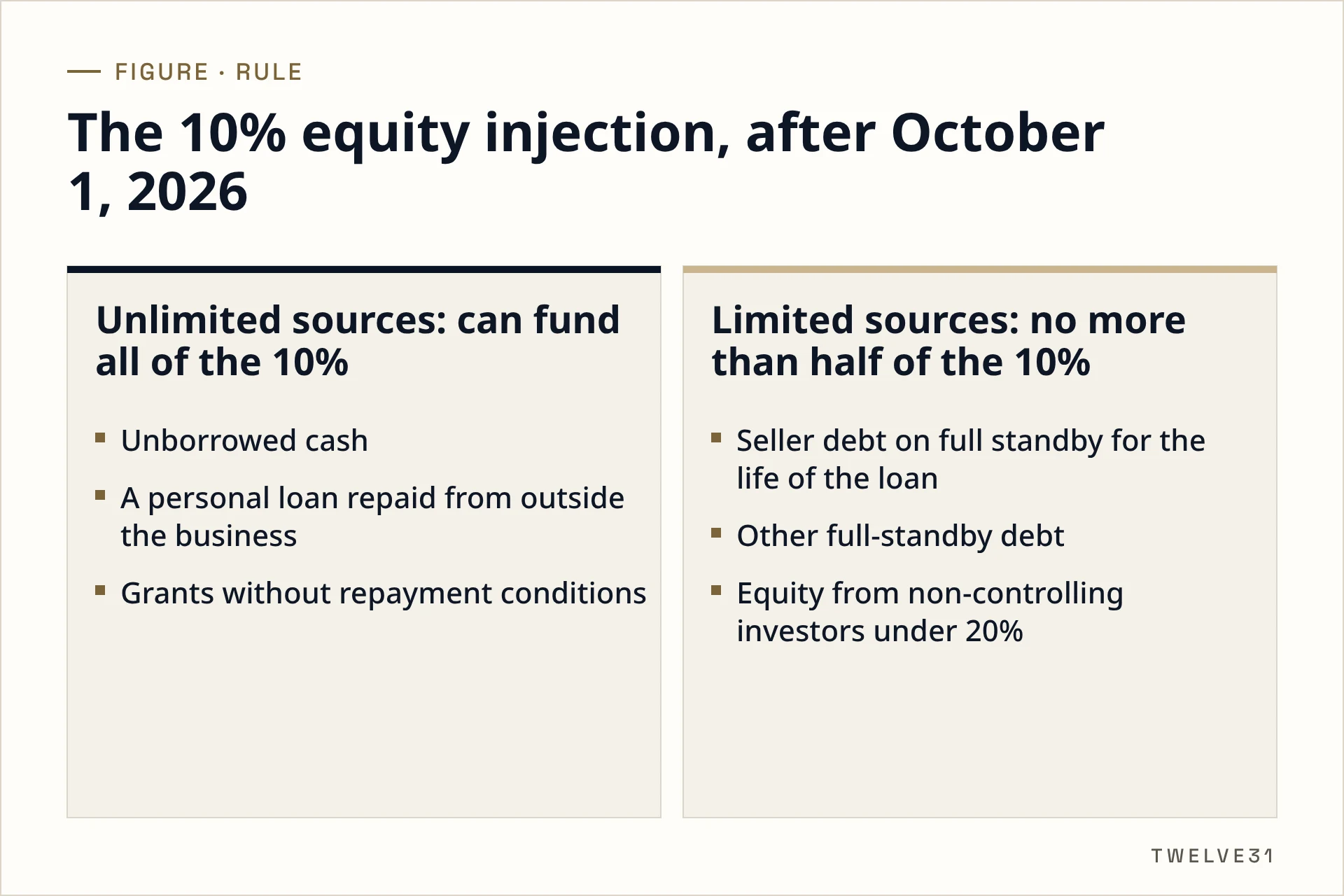
Unlimited sources include the buyer's own unborrowed cash, personal loans that will be repaid from sources outside the business, and unconditional grants.

Limited sources include standby debt, seller debt on full standby, and equity from non-controlling minority investors who hold less than 20 percent. Together these may supply no more than half of the required injection.
The practical result is that a buyer must bring at least 5 percent of project costs in cash that is truly the buyer's own. For business expansions and owner buyouts, lenders have discretion to reduce the injection where the existing business is financially strong.
A worked example: on a $2 million acquisition with $2.1 million of total project costs, the buyer needs an injection of $210,000, and at least $105,000 of it must come from unlimited sources. A structure in which the seller carries the entire down payment no longer works, and a buyer who planned to raise most of the injection from a group of small investors will need a different plan.
 (opens a larger view)
Seller notes
A seller note counts toward the equity injection only if it is on full standby for the entire term of the SBA loan. No principal or interest is paid for what is usually ten years. Few sellers accept that readily, and those who do tend to expect a higher price in return.
A seller note that receives current payments remains permissible as additional financing. It does not count as equity, and its payments are included in the coverage test. If it is interest-only, the lender must treat it as amortizing over ten years.
Interest on a full-standby note can accrue and be paid after the SBA loan is retired, which is a point worth negotiating. Lender summaries of SOP 50 10 8.1 also report that a seller note must now season 36 months, up from 24, before it can be refinanced.
Cash flow: historical results only
An initial acquisition must show a debt service coverage ratio of at least 1.25 to 1, up from 1.15. Business expansions remain at 1.15.
More significant than the ratio is the basis on which it is measured. Coverage must be met using historical or adjusted historical earnings, from either the most recent fiscal year or the average of the last two. Projections may be reviewed, but they cannot be used to satisfy the test.
Adjustments to historical earnings require written justification, and the buyer's compensation must be supported by an analysis of the buyer's personal financial needs. A buyer cannot make a loan work on paper by assuming a salary too low to live on.

Buyers should run the test themselves before writing a letter of intent: take the adjusted cash flow from the most recent year, subtract a market salary for the person who will run the business, and divide by the annual payment on the planned debt. If the result is below 1.25x, the price or the structure needs to change. For sellers, add-backs now carry more weight, because the lender sizes the loan on them. Each one should be supported by an invoice, a payroll record or a tax return line; an add-back that cannot be documented becomes a lower price.

Valuation and the debt cap
A business valuation is required for every change of ownership. Total transaction debt, including the bank loan and any seller note not on full standby, may not exceed that valuation.
If a buyer agrees to pay $1.4 million and the valuation supports $1.2 million, the $200,000 difference cannot be borrowed. It must come from additional buyer equity or a full-standby seller note. Sellers should understand that the lender's valuation now sets an effective ceiling on the financeable price.
Quality of earnings
For initial acquisitions and business expansions with a purchase price of $3 million or more, excluding owner-occupied real estate, the lender must obtain an independent quality of earnings report. It must reconcile bank activity to the income statement and tax returns for the trailing twelve months and the two prior fiscal years. The lender is required to use the report's normalized earnings in its coverage calculation.
Buyers should allow three to four weeks and budget for the cost.
The report includes a proof of cash that ties bank deposits to the financial statements, and it tends to surface issues that would otherwise appear after closing, such as revenue booked in the wrong period, inventory that is not there or customers lost in the most recent quarter. Sellers should reconcile monthly bank deposits to the books for the last 24 to 36 months before a buyer asks.
Other points that affect structure
- Earnouts are not permitted. The price must be fixed at closing.
- The seller's continuing role is limited. After a complete change of ownership, the seller may remain only as a consultant, for up to twenty-four months.
- Minority investors holding less than 20 percent are not required to guarantee the loan in a complete change of ownership, but where their equity counts toward the required injection, distributions to them beyond tax obligations are prohibited until the 7(a) loan is repaid.
- Partial purchases fall under the owner buyout category and require at least one original owner to remain and guarantee the loan.

A workable sequence for buyers
- Speak with an experienced SBA lender before making an offer. Lenders differ in appetite by industry and deal size.
- Document your equity. Have statements showing the source and seasoning of funds.
- Run the coverage test yourself on the seller's historical earnings, using realistic owner compensation, before proposing a price.
- Settle the seller note terms in the LOI, including whether any portion will be on full standby.
- Build sixty to ninety days into the timeline for underwriting, valuation, and where required, the quality of earnings report.
- Confirm which rules apply. The dividing line between the earlier SOP and SOP 50 10 8.1 is the date the SBA loan number is issued.
- Budget for the valuation and, on larger transactions, the quality of earnings report. Both count toward the injection when paid out of pocket.
What this means for sellers
Sellers benefit from understanding these rules as much as buyers. A business with clean historical earnings, documented adjustments and a price supported by a credible valuation is financeable. One priced on anticipated growth is not, at least not with SBA debt. Owners who want the widest pool of qualified buyers should price and prepare with the lender's tests in mind.
SBA requirements change periodically, and lenders apply them differently. Twelve31 Advisors structures acquisitions and coordinates with SBA lenders on behalf of buyers across the Midwest.

Owners preparing for a sale should obtain a credible value range before settling on a price, because the lender’s valuation will test it. They should decide in advance whether they will carry a full-standby note, for how much and at what accrued interest, since that decision can determine whether a transaction closes. And they should consider buyers who do not depend on SBA financing: independent sponsors and family offices often use a combination of bank debt and equity.
Sources
SBA rule references in this article reflect SOP 50 10 8.1, effective for loans numbered on or after October 1, 2026.
- Starfield & Smith: Best Practices, Change of Ownership Transactions Under SOP 50 10 8.1
- Accredited: New SBA Rules for Business Acquisitions Take Effect October 1, 2026
Also drawn on: SBA lender commentary published in October 2026, including First Internet Bank’s guest perspective for the Polsky Center at Chicago Booth (Oct. 21, 2026).
Multiples, percentages and timelines that are not SBA rules are illustrative market conventions. This article is general information, not legal, tax or lending advice; confirm the current SOP and its application with your lender and counsel before signing.